
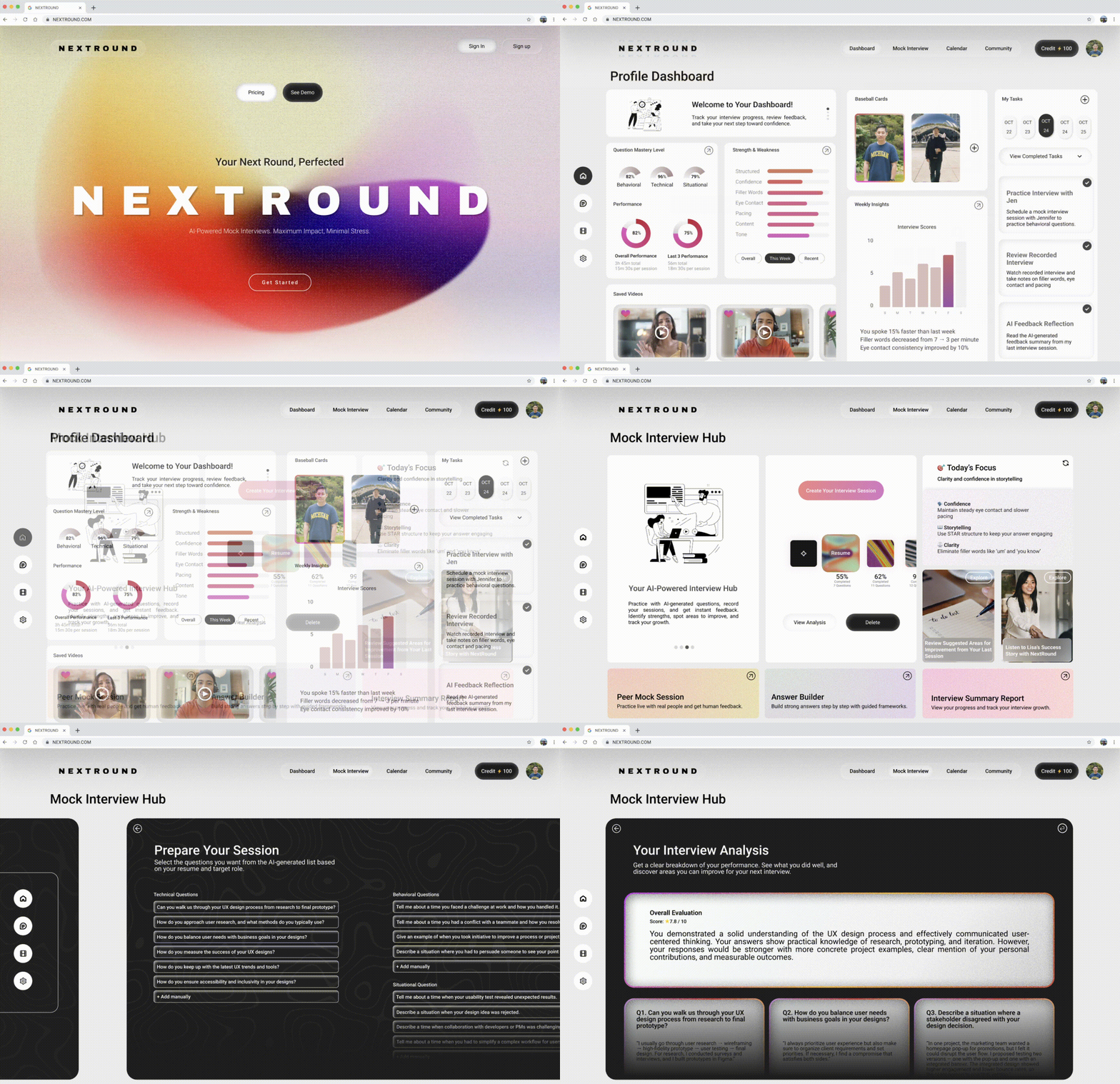
A platform that uses AI to help users practice interviews by generating tailored questions, analyzing their recorded responses, and enabling them to share their videos or interview questions with others.

AI-guided prep for real-world interviews — get ready for your NextRound with confidence.”
Our initial problem statement, “Students want something to practice job interviews so they can build skills, receive feedback, and feel more confident in real interview situations”, served as a starting hypothesis. However, through user interviews and contextual inquiries, it became clear that the challenge was more nuanced than simply providing practice opportunities.
Students were not only seeking a way to rehearse interviews but also struggling with identifying what to practice, understanding the reasoning behind feedback, and tracking their progress over time. Many expressed uncertainty about how to tailor their preparation to different roles and industries, and felt overwhelmed by generic or inconsistent guidance.
Project
Case Study
Timeline
Aug 2025 - Oct 2025
Role
Product Designer
Responsibilities
User Interview, UI Design, Usability Testing
Problem Statement
“Students want something to practice realistic job interviews and receive feedback so they can feel confident and prepared for real interview situations.”
Trust the Process.
I conducted user interviews to understand students’ needs for realistic interview practice, feedback, and peer learning. Based on these insights, I created Lo-fi wireframes and conducted usability tests to refine the design through multiple iterations. The Hi-fi prototype delivered a more intuitive and confidence-building experience for users.
Interview
After conducting user interviews, I found that students wanted realistic interview practice, actionable feedback, and opportunities to learn from peers. Based on these insights, we organized the findings into four key categories to guide the design of Nextround.
Category 1: Lack of Awareness of Resources
Pain point: “I don’t know what resources are available.”
Pain point: “I haven’t used U-M’s resources much because I don’t know if they exist.”
Pain point: “Not really, because I don’t even know what resources are available. I’ve heard of the Career Center, but I haven’t used it.”
Feeling: “It feels a little overwhelming to figure out where to start, so I usually end up preparing on my own.”
Category 2: Lack of Preparation Guidance
Pain point: “Many students are unsure which questions to focus on or how to present themselves convincingly.”
Feeling: “I felt unprepared because I didn’t know what behavioral questions to expect, and I hadn’t practiced explaining my past projects clearly.”
Pain point: “It’s hard to know what to prepare. Students often lack experience and opportunities to participate in more interviews.”
Category 3: Limited Practice Opportunities
Pain point: “Many students don’t have real interview experience and might not know what employers are looking for.”
Pain point: “Students may struggle because they don’t have a way to measure their performance or receive honest feedback.” →
Pain point: “Students may struggle to evaluate their readiness because they lack experience, opportunities for practice, and clear feedback from real industry perspectives.”
Category 4: Need for Industry-Relevant Guidance & Feedback
Pain point: “Because readiness is subjective. Without direct feedback, it’s hard to know if your answers are strong enough or if you’re presenting yourself in the best way.”
Pain point: “Without knowing how their answers compare to what employers expect, it’s hard to judge if they are truly prepared.”
Goal: “I think direct feedback from someone who has actually conducted interviews in the industry would help a lot.”
Goal: “Having resources with industry-standardized interview questions or support for mock interviews would be really helpful.”
Persona
“I can practice all I want, but without real feedback, how do I know if I’m actually ready?”

Bio
Alex Jones is a 31-year-old master’s student in User Experience Design at the University of Michigan. As he prepares for upcoming internships, he spends hours practicing interview questions, recording himself, and researching common hiring practices. Despite his efforts, he often feels stuck, unsure whether his answers are strong enough or aligned with what employers expect. He’s applied to multiple positions and attended a handful of interviews, but the lack of clear feedback leaves him frustrated and questioning his progress.
Age
31
Education
Masters in Information
Unsure if his answers are strong or just “good enough.”
Limited chances to practice with industry professionals or recruiters.
Conflicting advice online creates confusion about what really works.
Pain Points
Location
Ann Arbor, MI
To have a clear, actionable feedback on interview performance.
To have access to realistic mock interview opportunities that simulate real industry expectations.
To have a way to measure interview readiness beyond self-assessment.
Goals
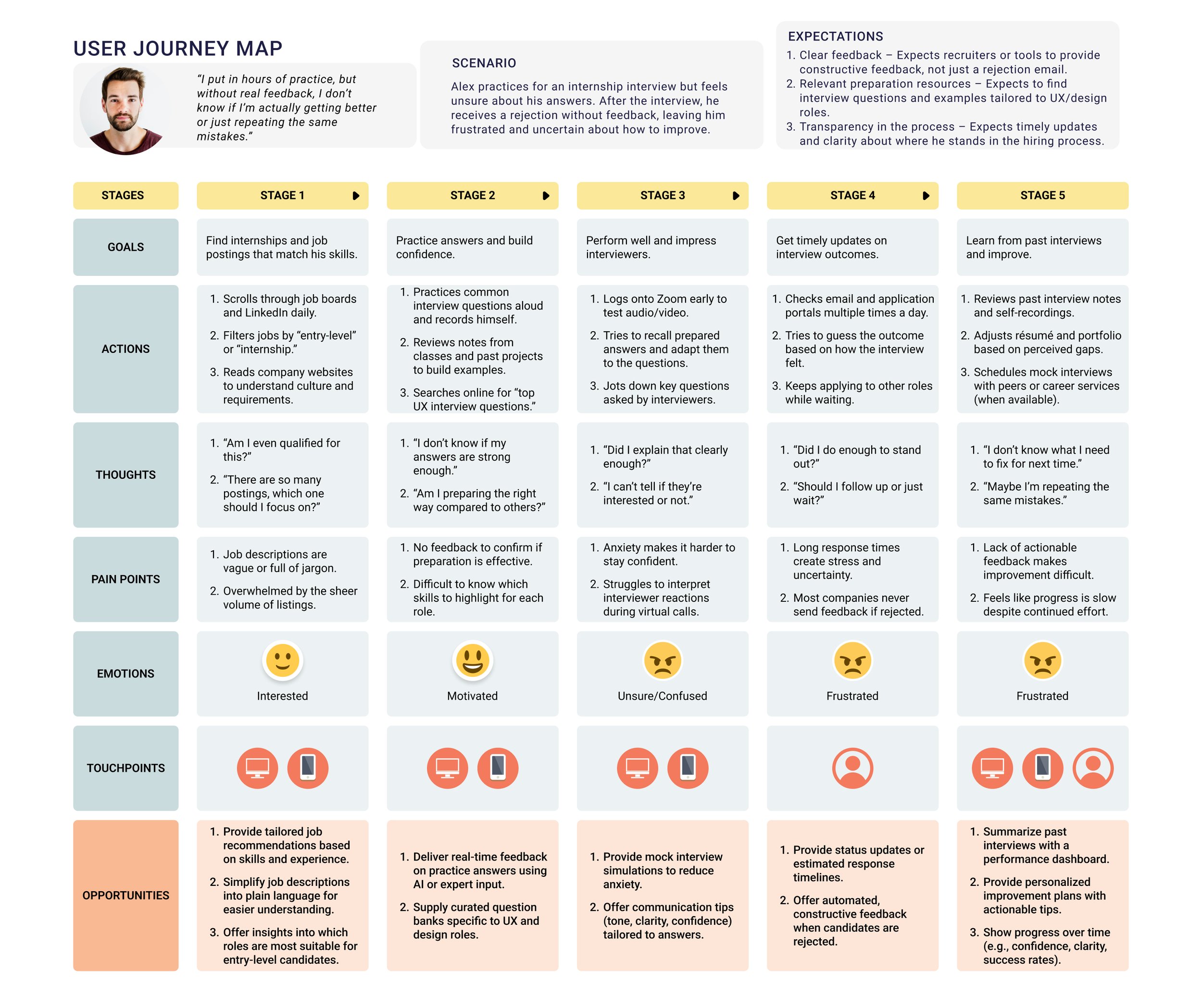
User Journey Map
By mapping the user journey, I identified key moments of frustration and motivation, translating them into actionable design insights.
Implication for my design
Implication for my design
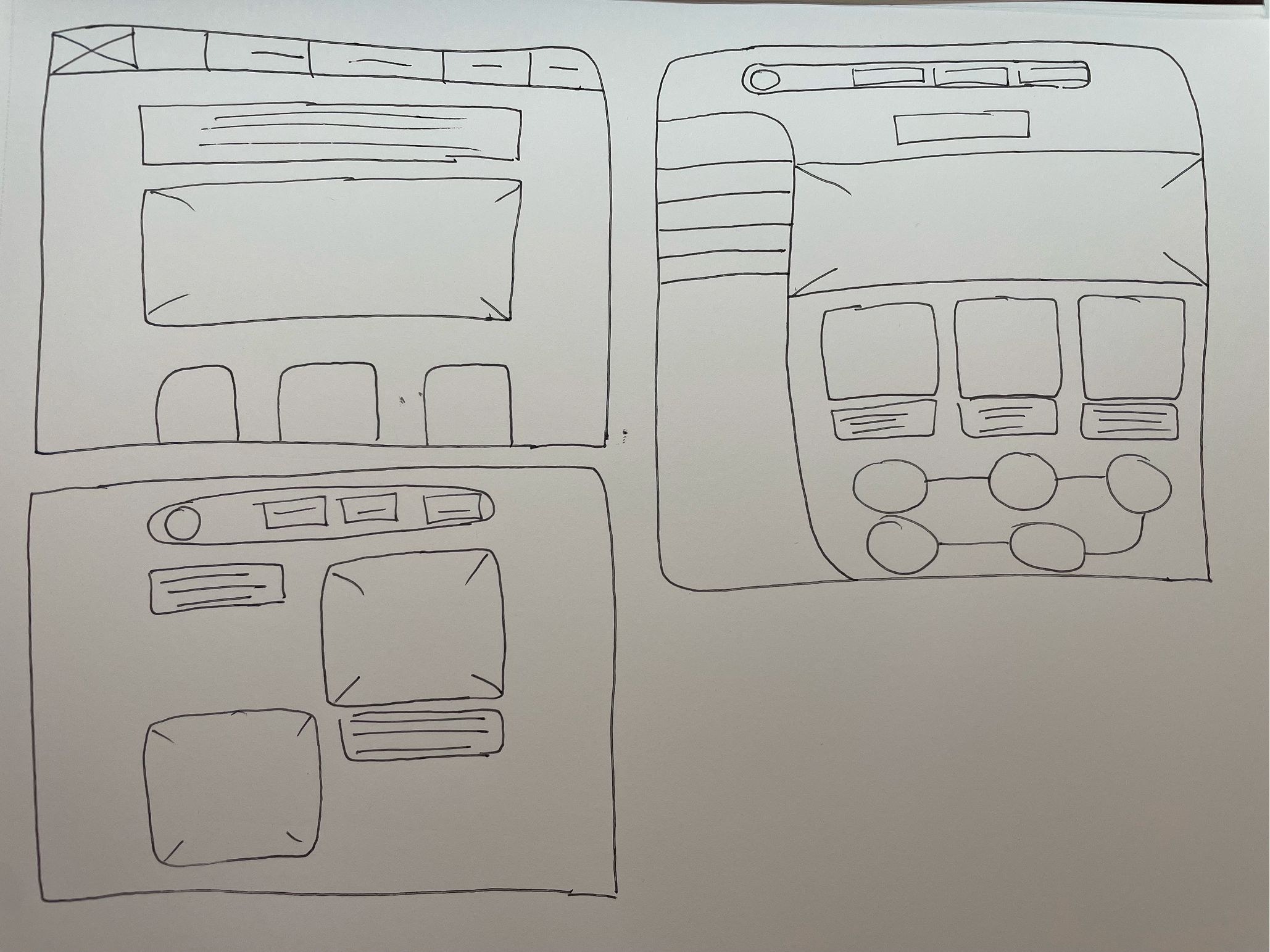
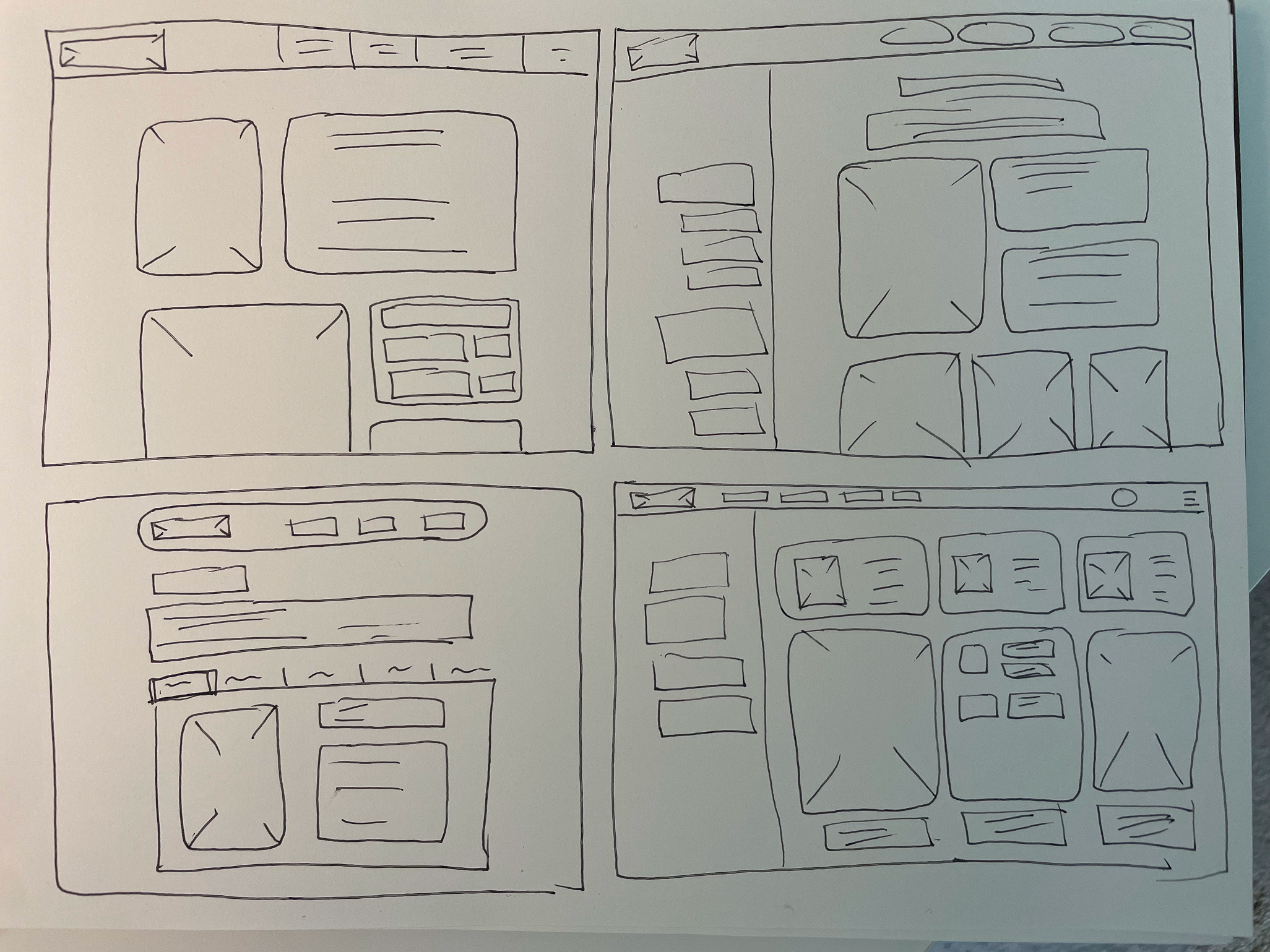
After receiving feedback on my low-fidelity designs, several key areas for refinement became clear.
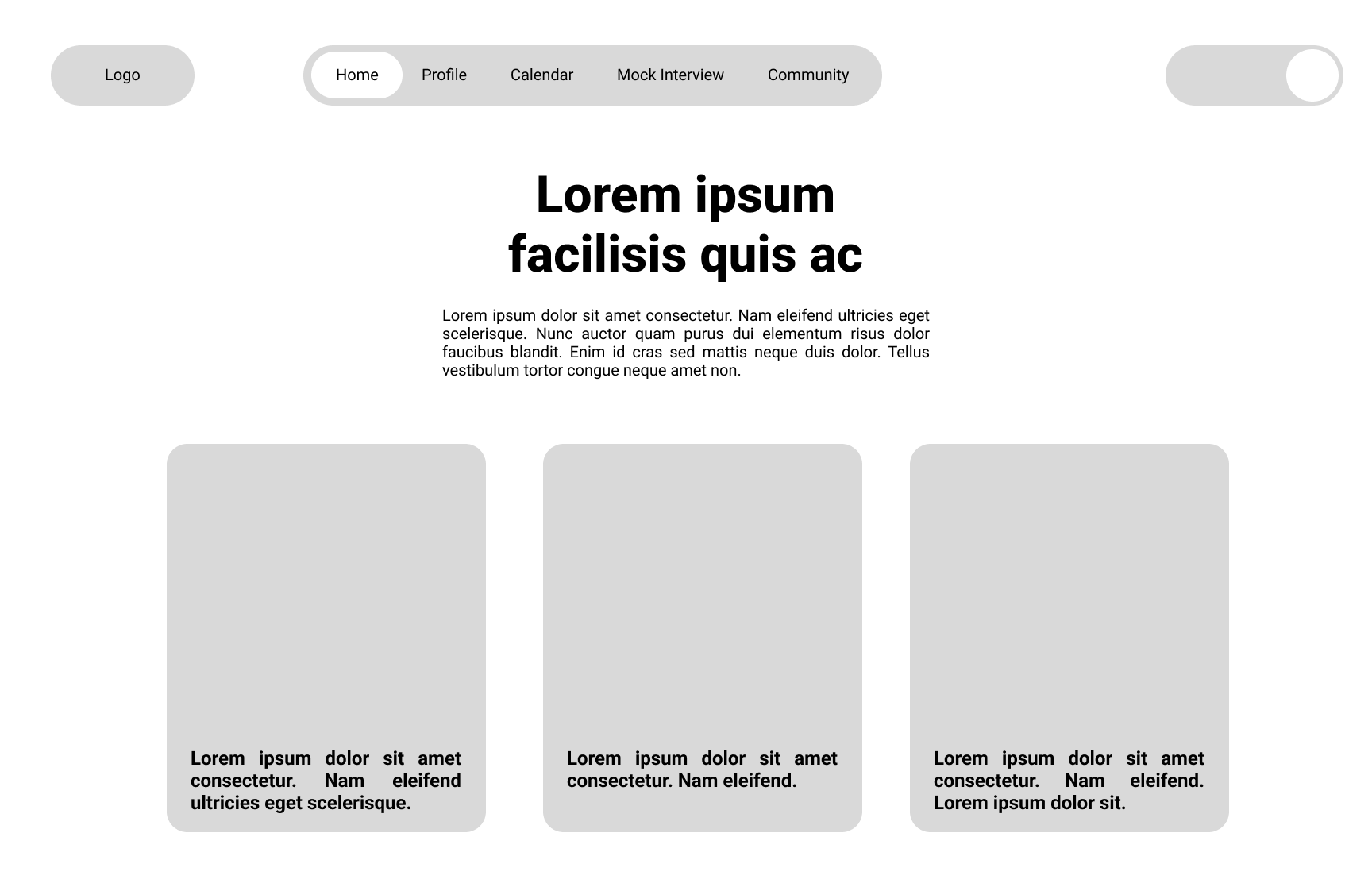
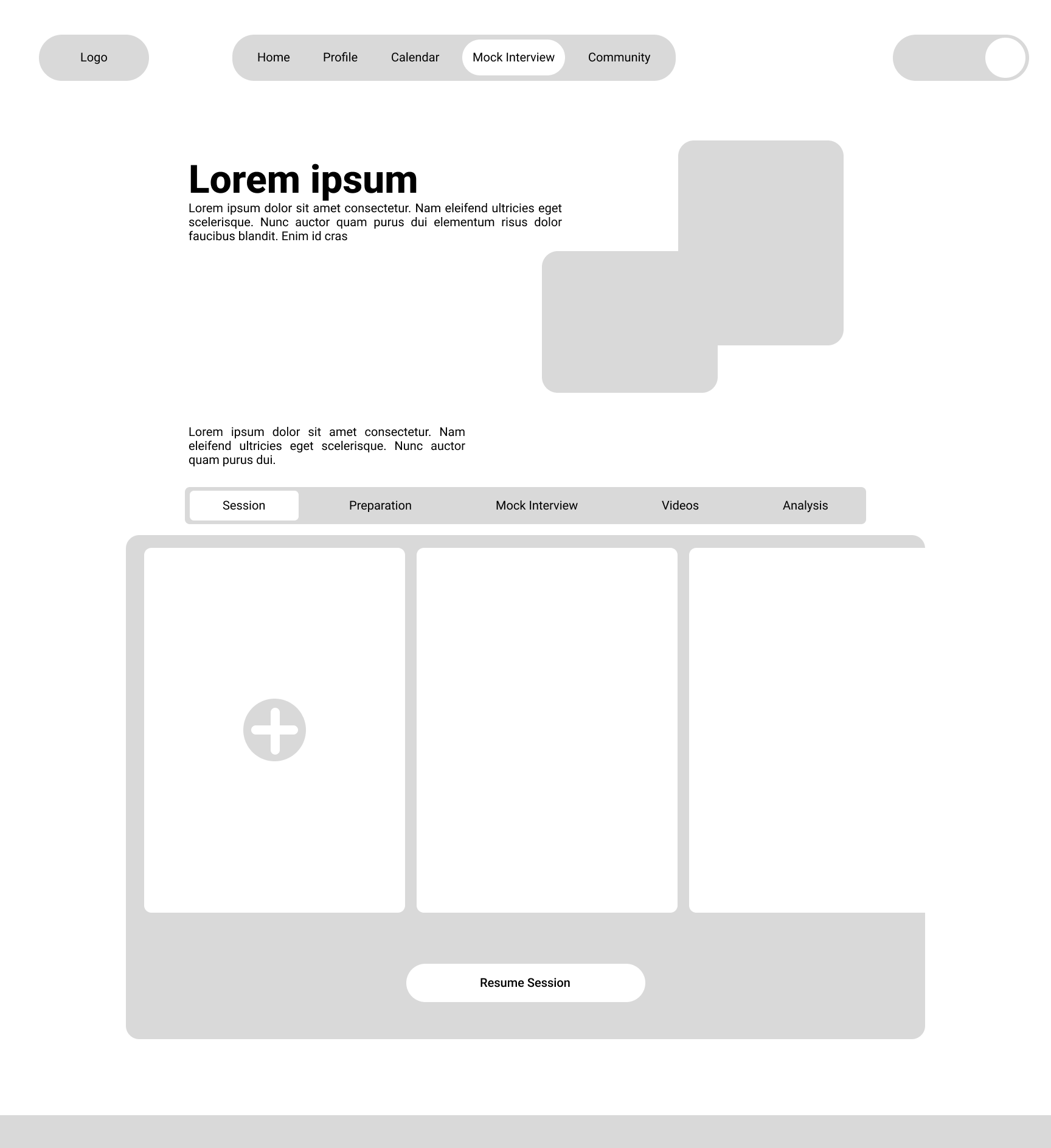
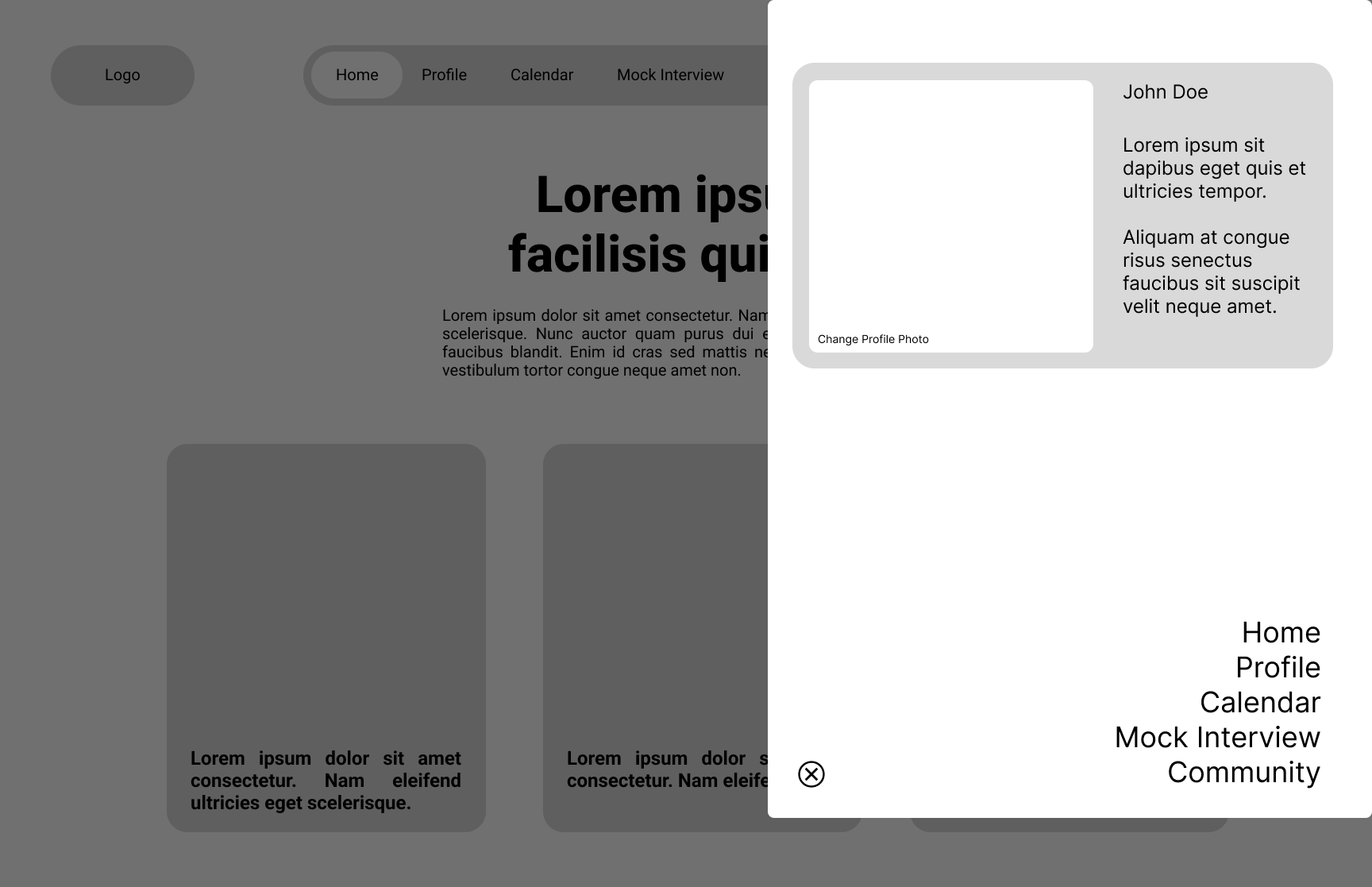
The feedback highlighted the importance of refining the visual proportions of my layout. The current card and image sizes appear oversized, which may become more pronounced in high-fidelity designs. To address this, I need to reassess spacing, scale, and component measurements to ensure that the interface feels balanced and realistic across screen sizes.
The confirmation that the navigation bar and dropdown menu are intuitive reinforces that their current structure is effective, allowing me to move forward with confidence while focusing my attention on improving visual hierarchy and component sizing.
“Students may struggle because they don’t have a way to measure their performance or receive honest feedback”
— G. Ban
Lo fi Wireframes
Lo-fi wireframes helped visualize and test Nextround’s main features and navigation early on


Turning Feedback Into Better Design
After creating the lo-fidelity designs, I conducted a round of usability testing and gained additional insights that helped refine the final experience.
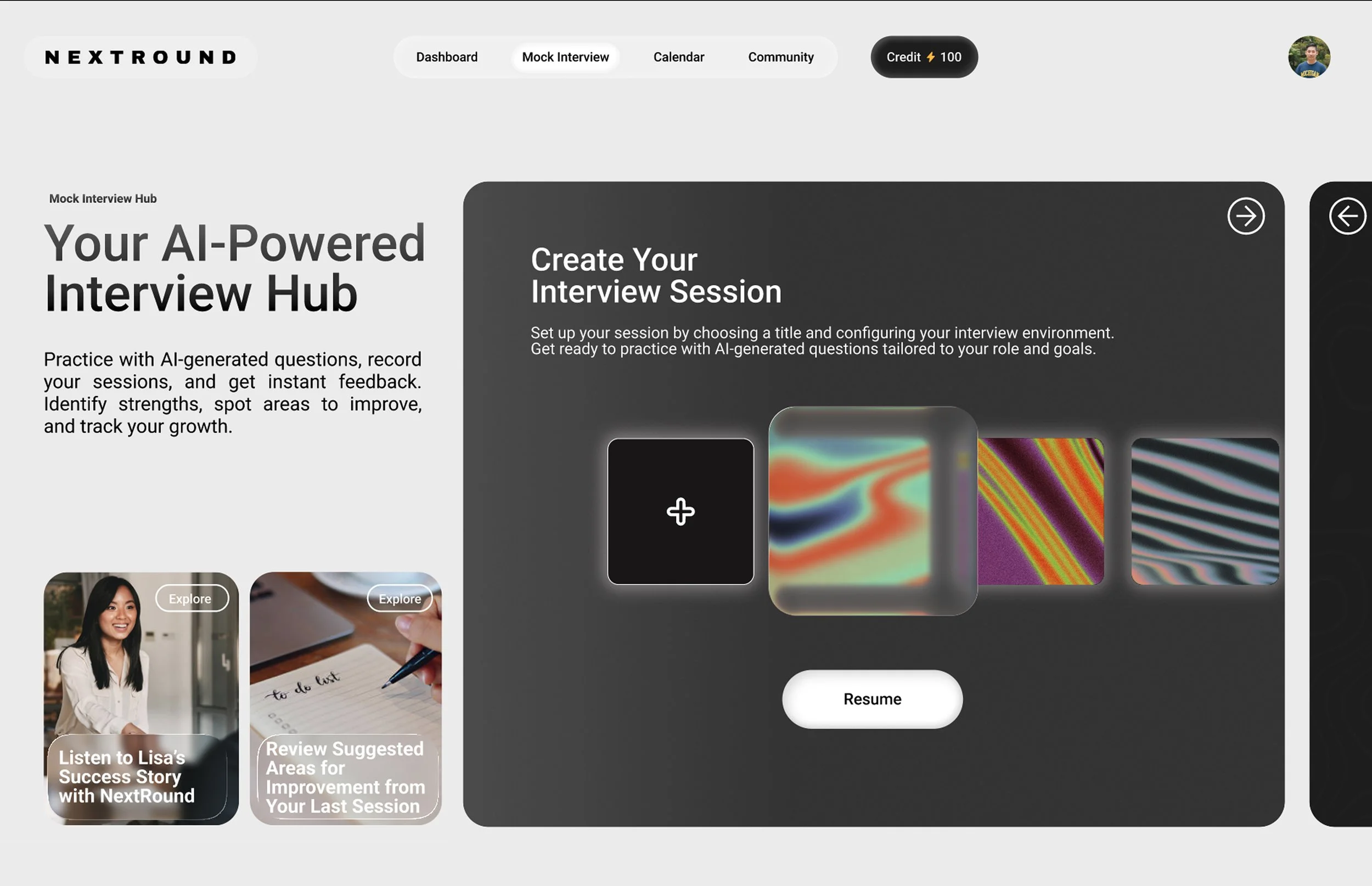
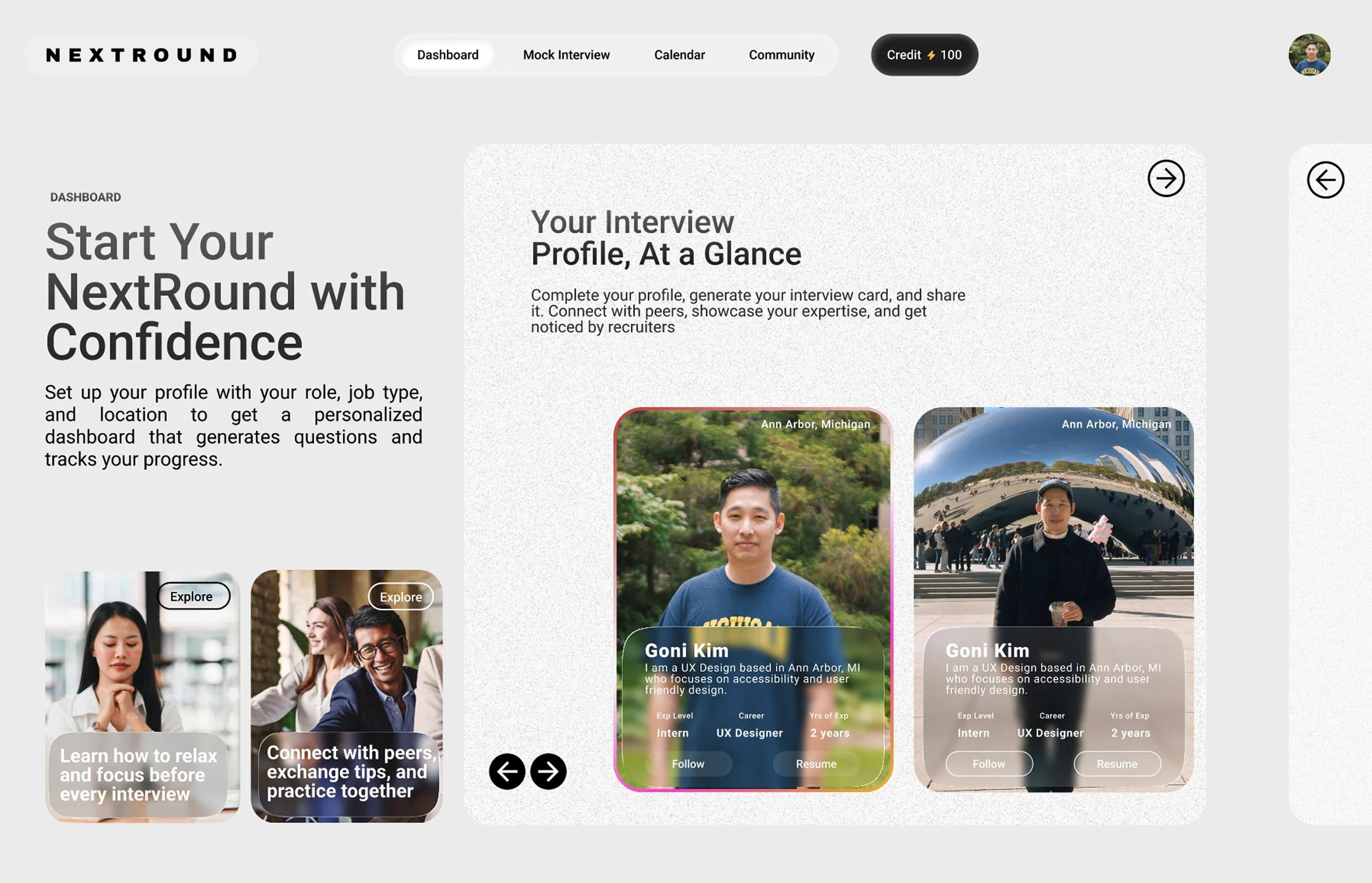
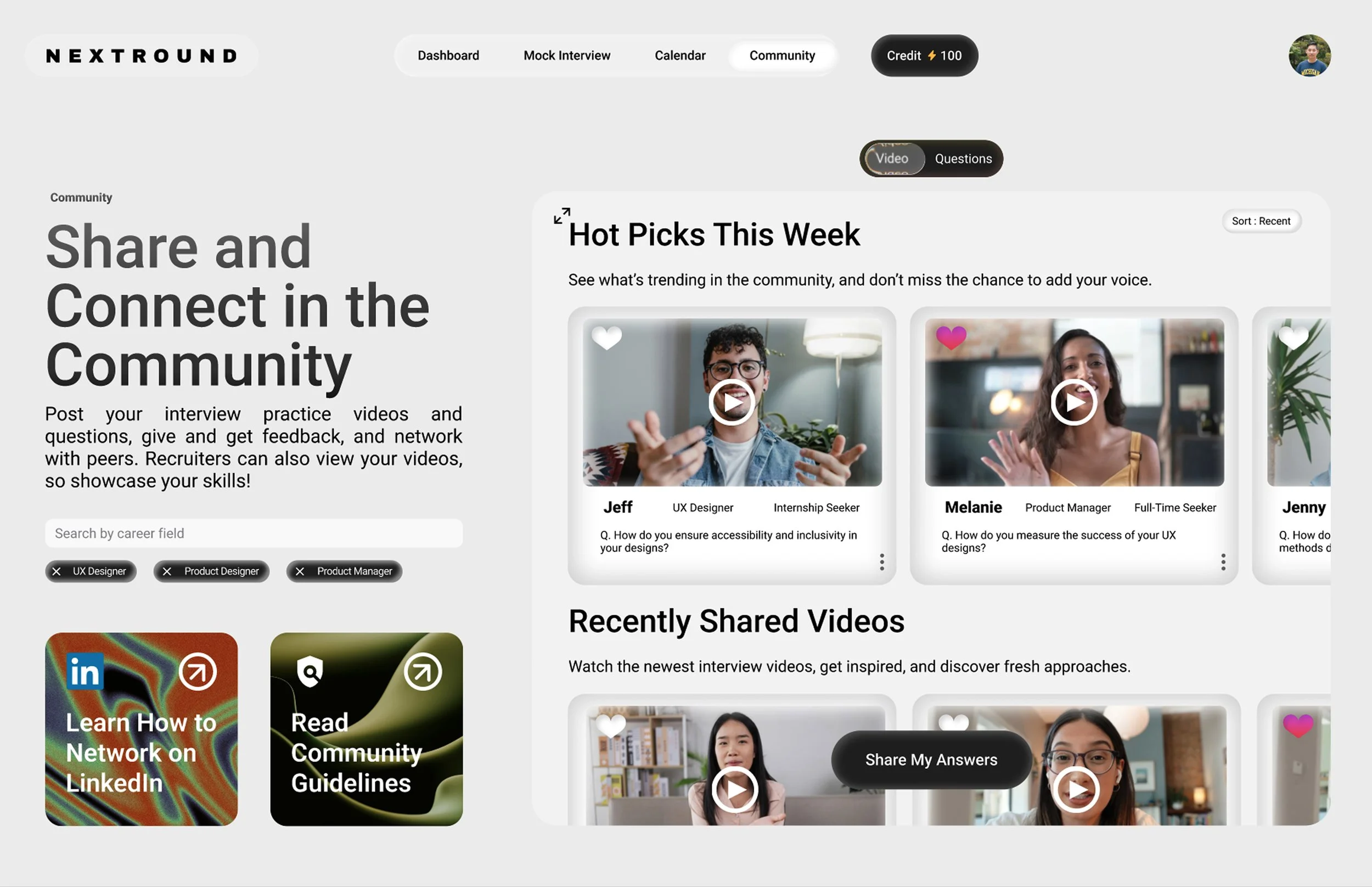
I reduced the width of the left column, replaced it with icons for quick navigation to other pages, and restructured the layout to center the main content, allowing the primary functions to utilize more screen space and making it easier for users to interact with.
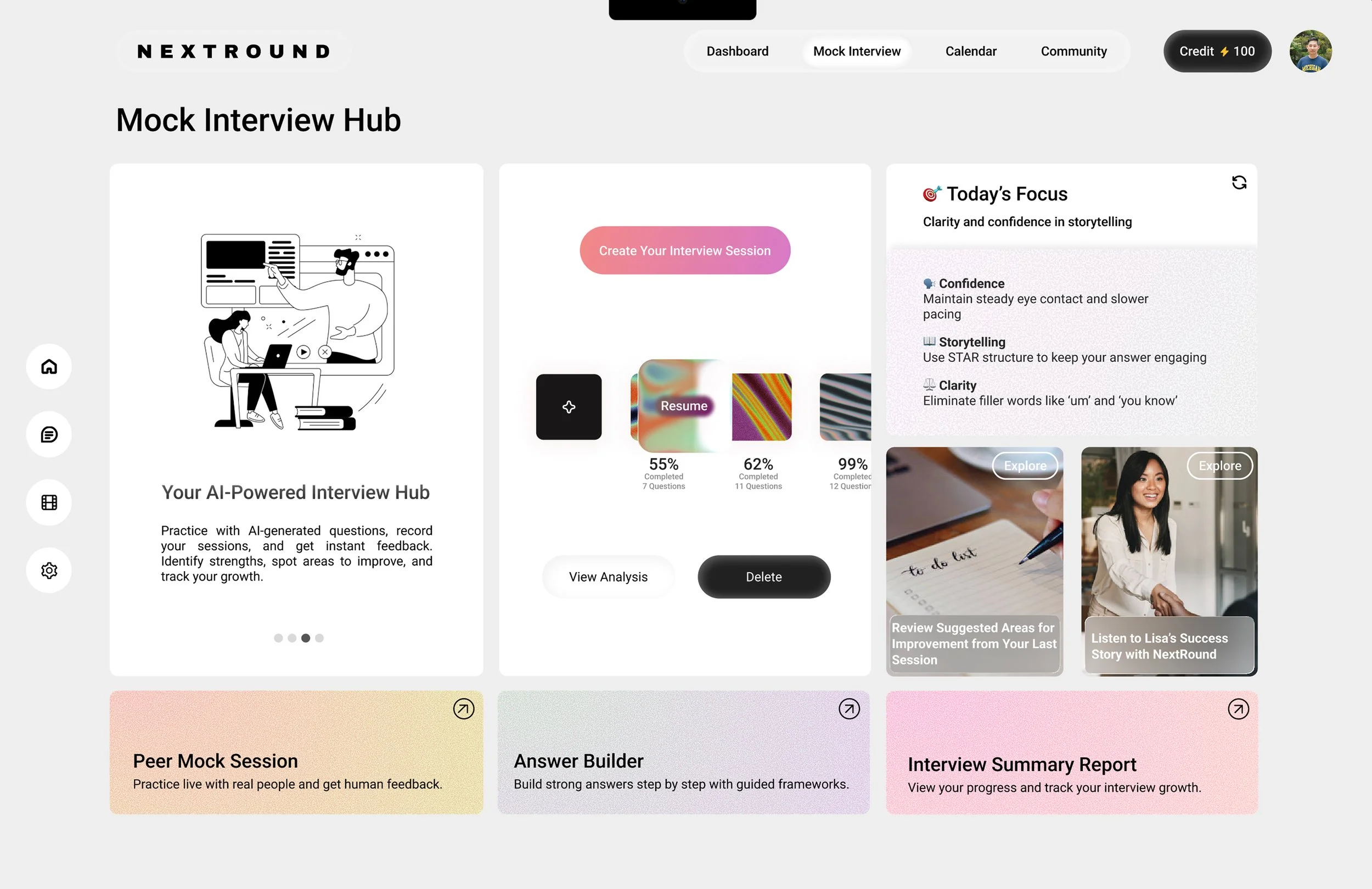
I updated my design system to incorporate the red-to-purple gradient more throughout the website. However, I made sure not to overwhelm the interface, since the dominant color is greyscale and using a bright gradient excessively could be distracting and visually unappealing. I also used variations and tints of the red-to-purple gradient in boxes and buttons to subtly introduce users to the primary color while maintaining a balanced and harmonious design.
Removed those explore buttons and removed the oversized 64pt title and kept the title area simple as recommended. I also implemented a dashboard layout to enhance readability and make better use of the available screen space.
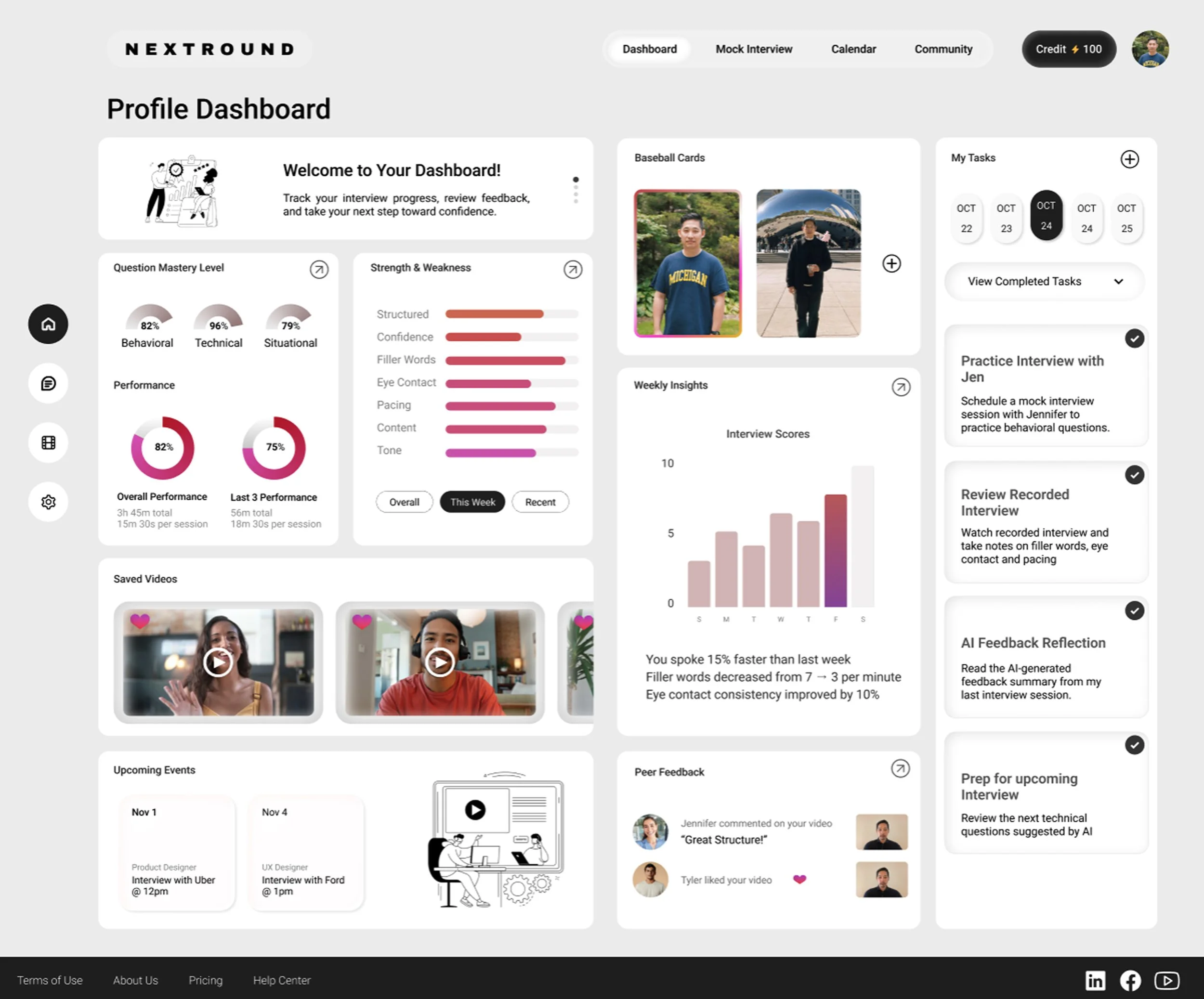
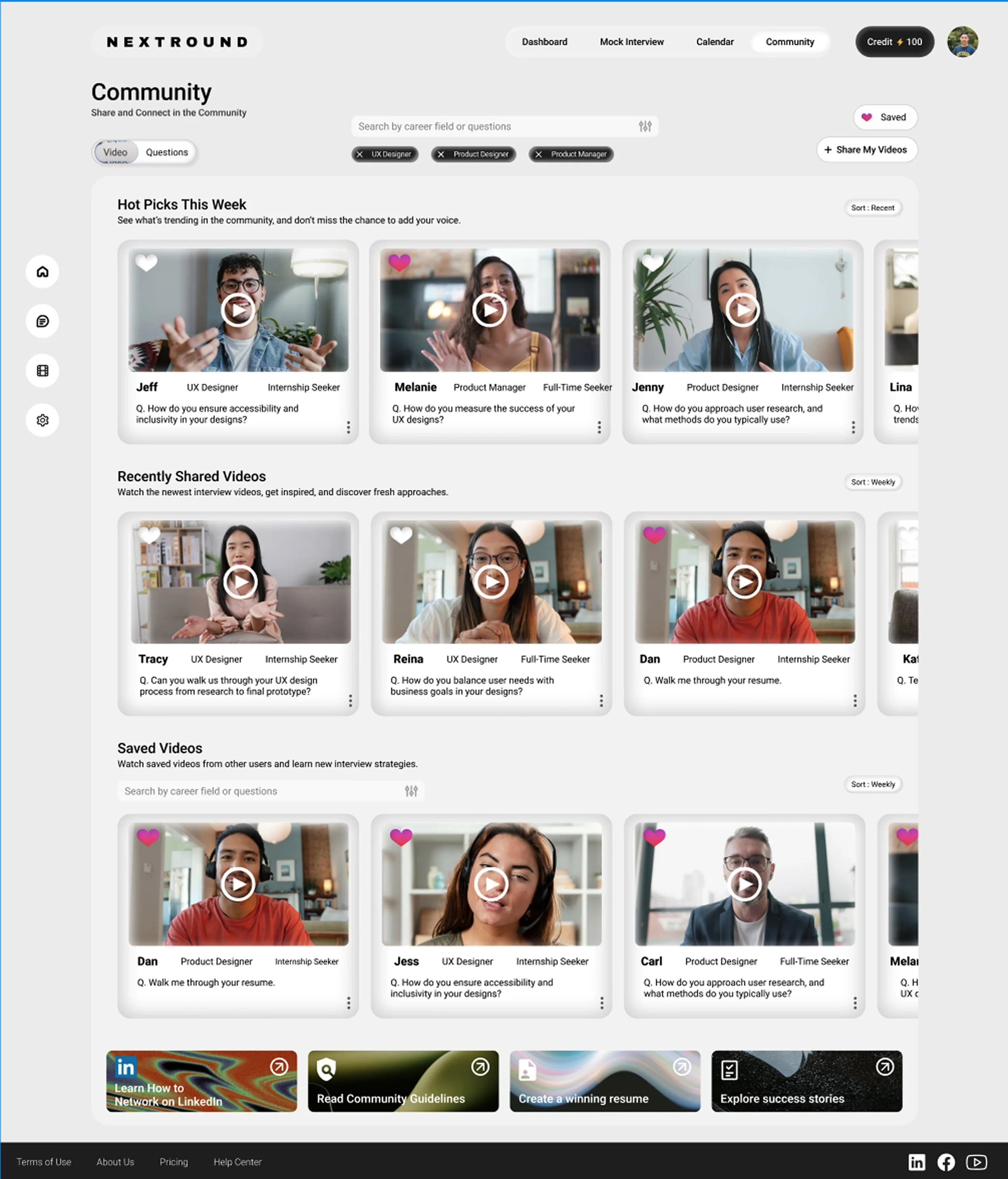
Following Lo-fi prototyping and usability testing, I translated user feedback into a Hi-fi prototype—enhancing visual design, interaction flow, and overall user confidence.”
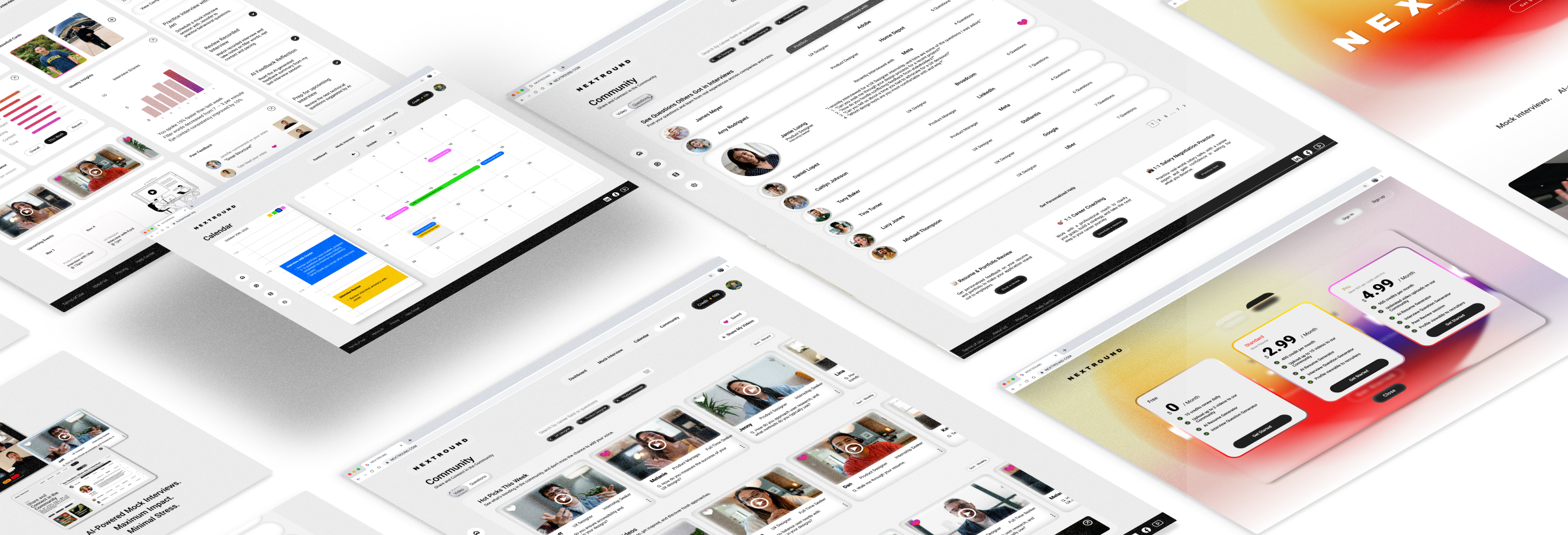
Hi fi Wireframes
Next Steps
My next steps for this product are to finish designing the remaining UI components, such as the messaging feature and the page where users can view their saved videos and interview questions. I also plan to design and build external pages that connect users to additional career resources, including resume review and career coaching support.
To build and implement this product, I will need to expand the website’s scope and create a new UX design system that supports a platform for career coaches. This will include a coach listing page, profile management tools, and a booking system that allows users to schedule one-on-one sessions.
I should contact career service professionals at universities (such as U-M’s Career Center), UX designers with experience in scalable platform design, and industry coaches or mentors who can provide insight into coaching workflows and user needs. I should work with AI-related professionals and developers to ensure the system’s AI feedback and analysis components are accurate, transparent, and trustworthy, aligning with ethical AI design standards.
Lesson Learned
A design system is essential. It makes my workflow easier and helps maintain consistency in my design decisions.
Getting feedback early in the design process is crucial for saving time. I feel like I received feedback a bit too late in my process, which now makes me feel like I need to redesign a large portion of my work.