
Industry
Automotive
Written
Redefining EV Refueling: Autonomous Battery Swapping for Zero Downtime Driving
An autonomous EV battery swapping platform that replaces slow charging with a fast, robotic battery exchange. The product minimizes charging time and range anxiety by enabling drivers to swap depleted batteries in minutes through standardized swap stations.
01/16/2026
Use Case
Autonomous battery
Author
Goni Kim
Problem Definition
The Core Problem

Electric vehicles face two critical adoption barriers: long charging times and range anxiety. While EV technology has advanced rapidly, the refueling experience remains fundamentally slower and less predictable than traditional gas vehicles.
Why Existing Solutions Fall Short
Fast charging reduces wait times but introduces new problems such as battery degradation, high infrastructure costs, and grid strain. Increasing battery capacity improves range but raises vehicle cost and weight, negatively impacting efficiency.
PM Lens
This is not just a technology limitation. It is a user experience and system-level problem where time uncertainty and infrastructure availability reduce trust in EVs as a primary transportation option.
Users & Jobs-To-Be-Done
Primary User Segment
High-Utilization Urban EV Drivers:
This product is not designed for all EV owners.
The value of battery swapping is highest for users who rely on their vehicles frequently and operate under time constraints.
Representative users include
Rideshare drivers (e.g., Uber, Lyft)
Delivery and logistics drivers
Urban EV drivers without access to home charging
Understanding the Job to Be Done (JTBD)
Focus Job: The core task the user is trying to accomplish.
Adjacent Jobs: Related roles or responsibilities in the same system that support or interact with the focus job.
Aspirations: Identity-level outcomes the user seeks by performing the job.
Job Steps: The chronological process of completing the job, structured according to the standard JTBD map (Plan → Prepare → Execute → Monitor → Modify → Conclude).
Success Criteria: How the user measures effectiveness in performing the job.
Emotions: Feelings experienced throughout the job that influence decisions and satisfaction.
Circumstances: Situational factors that impact how the job is performed.
Goals And Metrics
Objective: Enable high-utilization EV drivers to restore mobility quickly and predictably, minimizing downtime and maximizing operational efficiency.
Key Goals:
Minimize vehicle downtime during battery refueling or swapping
Maximize swap station availability and reliability
Reduce cognitive effort for drivers when planning refueling
Maintain battery health across repeated swaps
Success Metrics:
Average swap time (minutes)
% of successful swaps without delay
Driver confidence / satisfaction (survey-based)
Reduction in trip disruptions or schedule deviations

SWOT Analysis
This section evaluates the strategic position of the autonomous EV battery swapping solution.
It highlights internal strengths and weaknesses of the system, as well as external opportunities and threats in the market and operating environment.
The insights guide prioritization, trade-offs, and MVP decisions.
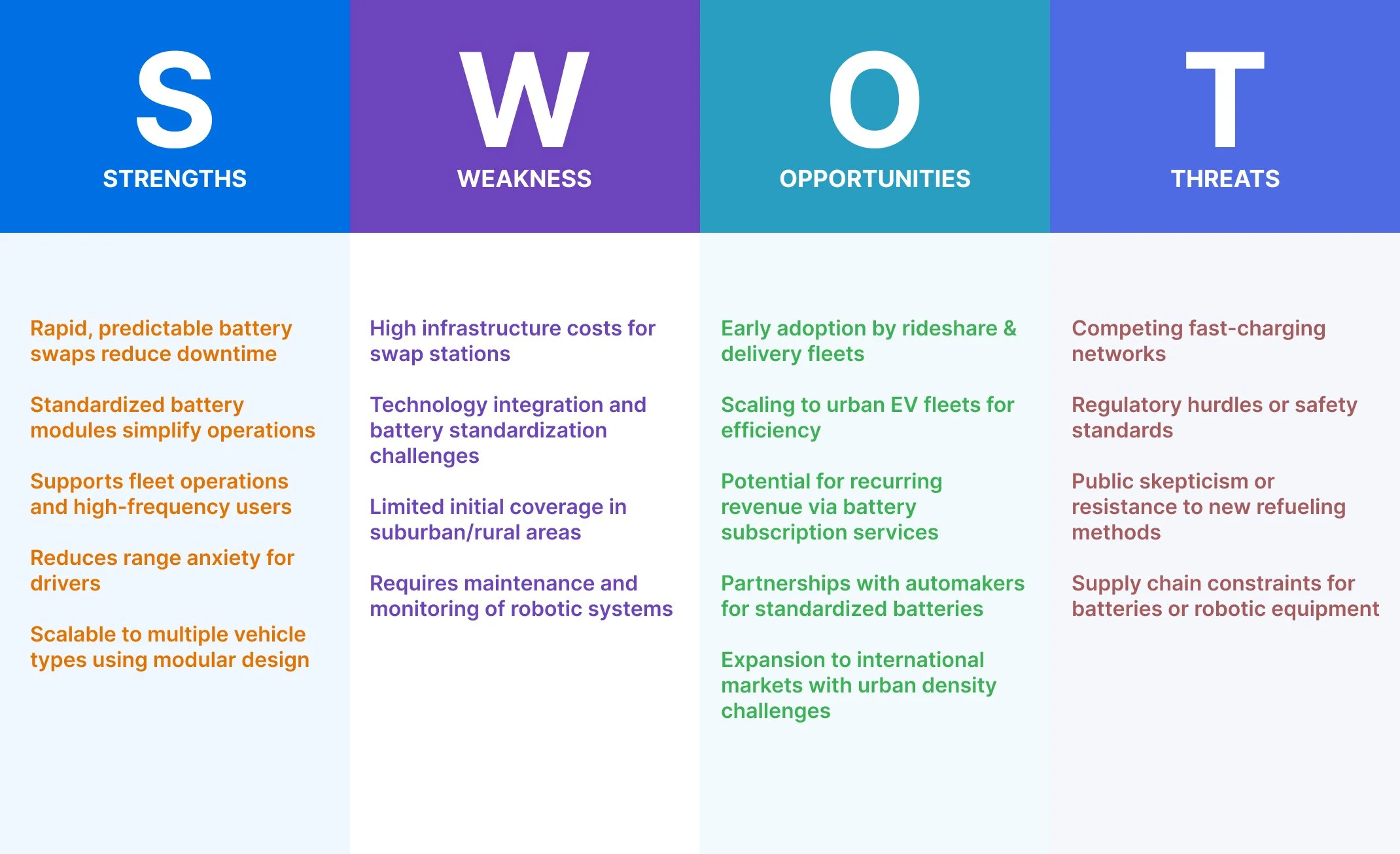
Insights & Prioritization
Prioritize MVP features:
Station availability and swap speed → High priority
Autonomous robotic swapping → Medium priority, high tech risk
Fleet management dashboard → Medium priority
Trade-offs:
Coverage vs. cost: prioritize urban/high-frequency routes first
Automation vs. reliability: ensure manual fallback in early MVP
Strategic Insight:
Solutions that reduce downtime uncertainty deliver the highest perceived value
Aligning adjacent roles (station operators, battery technicians, fleet managers) is critical for smooth adoption
Solution Overview
This product proposes an autonomous EV battery swapping platform designed to fundamentally rethink how electric vehicles are refueled. Instead of relying on slow, variable charging sessions, drivers can swap a depleted battery for a fully charged one at standardized swap stations in just a few minutes - making EV refueling fast, predictable, and routine.
The system combines robotic battery exchange with real-time software intelligence. Drivers can view station availability, anticipate wait times, and plan routes around battery swaps with confidence. For fleet operators, a centralized dashboard provides visibility into battery health, vehicle readiness, and station utilization, enabling higher vehicle uptime and operational efficiency.
By decoupling energy replenishment from charging time, this solution addresses one of the most persistent barriers to EV adoption: uncertainty. The platform is designed to scale across high-frequency use cases such as ride-hailing and delivery fleets, while remaining intuitive and trustworthy for everyday drivers. Ultimately, the goal is to make EV ownership feel as seamless and dependable as refueling a gas-powered vehicle—without compromising safety, performance, or system resilience.
Feature Prioritization & MVP Scope
Objective: Identify the core features to test in the minimum viable product (MVP) that address the focus job of restoring mobility quickly and predictably, while balancing feasibility, impact, and risk
Core MVP Features (High Priority)
Epic 1: Rapid & Predictable Battery Swapping
Features:
Autonomous Battery Swap: Vehicles exchange depleted batteries automatically and reliably, minimizing downtime.
Vehicle Readiness Verification: Confirms swapped battery is fully functional and safe before resuming operation.
Real-Time Station Availability: Drivers receive live updates on swap station status, queues, and wait times.
Epic 2: Driver Experience & Route Optimization
Features:
Route Planning Integration: Suggests optimal swap station based on battery level and planned trips.
Cognitive Load Reduction: Minimizes driver effort in scheduling swaps and planning trips.
Notifications & Alerts: Provides timely guidance on swap completion, battery health, and potential disruptions.
Epic 3: Fleet Operations & Management
Features:
Fleet Management Dashboard: Operators monitor battery health, station usage, and vehicle scheduling across multiple vehicles.
Predictive Maintenance Alerts: Flags batteries needing service before causing downtime.
Analytics & Reporting: Tracks swap efficiency, uptime, and operational KPIs to guide strategic decisions.
Medium Priority Features (Future Enhancements)
Epic 1: Predictive & Proactive Systems
Features:
Predictive Battery Maintenance Alerts: Flags batteries needing service before causing downtime.
Epic 2: Ecosystem & Integration
Features:
Integration with Third-Party Ride-Sharing Apps
Subscription-Based Battery Swap Service
Epic 3: Operational Scalability
Features:
Automated Billing/Payment System at Stations
Multi-Station Coordination for High-Frequency Routes
Prioritization Rationale
High Priority Features: Directly solve the focus job and test core JTBD hypotheses. Essential for initial MVP validation.
Medium Priority Features: Enhance user experience, scale operations, or add value but not required to validate core job.
Decisions guided by: impact on Focus Job, technical feasibility, cost, risk
Assumptions & Constraints
This solution is built on several key assumptions and constraints that shape both the product scope and implementation strategy.
Key Assumptions
EV manufacturers adopt or support standardized battery form factors for swapping.
Drivers value time predictability over battery ownership and are open to battery-as-a-service models.
Battery swapping delivers comparable safety and performance to traditional charging.
High-frequency use cases (e.g., fleets, ride-hailing, delivery) will drive early adoption.
Key Constraints
High upfront capital costs for swap stations and robotic infrastructure.
Regulatory and safety requirements governing battery handling and automation.
Limited initial geographic coverage during early rollout phases.
Dependency on reliable battery supply chains and maintenance operations.
These assumptions and constraints informed a phased MVP approach, prioritizing controlled environments and high-impact use cases before broader expansion.
Risks & Mitigations
Introducing autonomous battery swapping presents several technical, operational, and adoption risks. Each risk is paired with a mitigation strategy to reduce uncertainty and support iterative validation.
Risk: Low user trust in automated battery swapping
Mitigation: Start with fleet pilots and transparent safety verification at each swap.Risk: Battery standardization resistance from OEMs
Mitigation: Partner with select manufacturers and target fleet-specific vehicle platforms first.Risk: High operational downtime at swap stations
Mitigation: Implement redundancy in robotic systems and predictive maintenance alerts.Risk: Regulatory delays or compliance issues
Mitigation: Engage regulators early and align system design with existing safety standards.Risk: Competition from improving fast-charging technology
Mitigation: Focus on use cases where downtime predictability matters more than peak charging speed.
Future Opportunities
Once the core battery swapping system is validated, several opportunities emerge to expand value and scale the platform.
Energy-as-a-Service Models: Subscription plans for unlimited swaps or fleet-based pricing.
Grid & Energy Optimization: Using batteries as distributed energy storage to balance grid demand.
Autonomous Vehicle Integration: Seamless battery management for self-driving fleets.
Global Expansion: Deployment in dense urban markets where charging infrastructure is constrained.
Data & Insights Platform: Leveraging swap and battery health data to optimize vehicle design and infrastructure planning.
These opportunities position the platform not just as an EV refueling solution, but as a foundational layer for future electric mobility ecosystems.
FAQs
Why battery swapping instead of fast charging?
1
Fast charging reduces wait time but still introduces uncertainty, battery degradation, and grid strain. Battery swapping reframes the problem by separating energy replenishment from time spent waiting. The goal is not just speed, but predictability and confidence, especially for high-frequency drivers and fleets.
Who is this solution primarily for?
2
The initial focus is on fleet operators and high-usage drivers such as ride-hailing and delivery services, where downtime directly impacts revenue.
The system is designed to later scale to everyday drivers once infrastructure density and trust are established.
Does battery swapping require standardized batteries?
3
Yes. Standardization is a core assumption and a known constraint.
This solution intentionally targets controlled environments (fleets, partnerships with OEMs) first, where standardization is more feasible before broader consumer adoption.
How does this solution address safety concerns?
4
Each swap includes automated verification to confirm battery health, compatibility, and readiness before the vehicle resumes operation.
Starting with fleet pilots allows the system to validate safety and reliability under monitored conditions.
What makes this a product problem, not just a hardware problem?
5
What would success look like for the MVP?
6
How does this coexist with improving charging technology?
7
What would you validate first if this were real?
8
The core challenge is not swapping batteries—it’s orchestrating time, trust, and coordination across drivers, stations, and operators.
Software intelligence (availability, routing, monitoring, and metrics) is what makes the experience reliable and scalable
Success would be measured by reduced vehicle downtime, consistent swap completion times, and repeat usage among early adopters.
The MVP is considered successful if drivers plan trips around battery swapping with confidence rather than anxiety.
This solution is not positioned as a universal replacement for charging.
It targets use cases where time certainty matters more than peak charging speed, complementing existing charging infrastructure rather than competing directly.
The first validation would focus on user trust and operational reliability:
Can drivers rely on the system without intervention, and does it consistently meet promised swap times?